

Can Follow-Up Texts Turn a Conversation into a Binding Agreement?
Imagine you meet a seller to discuss buying a piece of property. Later, you both exchange a short string of text messages confirming the price, the closing date, and a simple “I agree” from each side. Could those follow-up texts be treated as part of a legally binding contract in Texas?
Texas courts have not issued a final ruling on that question. However, courts in states such as New York, Massachusetts, and California have held that a text message can help create or confirm an enforceable contract when all the required elements are present.
When a Text Message Could Be Evidence of a Contract
Whether a text qualifies as a contract depends on its content.
To be enforceable under Texas contract law, a text message (or a series of texts) must include all the traditional elements of a valid agreement:
- Offer – a clear proposal of terms.
- Acceptance – an unambiguous agreement to those terms.
- Consideration – something of value exchanged by both sides.
- Capacity – parties capable of entering a contract.
- Signature – an indication that each party intended to sign and be bound.
If those five requirements appear in the message thread, a court could view the texts as either a valid contract or a valid amendment to an existing contract.
Texas Cases Point the Way
The Texas Supreme Court has not ruled directly on text messages but has examined similar issues involving email agreements.
In two decisions, the court held that certain email exchanges did not create enforceable contracts because the messages lacked one or more of the required elements.
However, the justices stressed that emails can create binding contracts when:
- All contract formation requirements are present
- There is a clear meeting of the minds
- The emails show a present intent to be bound
These opinions signal that Texas courts are open to treating electronic communications, including text messages, as valid contracts when the evidence supports it.
The Signature Requirement Under Texas Law
Texas follows the Uniform Electronic Transactions Act (UETA), which recognizes an electronic signature as “an electronic sound, symbol, or process attached to or logically associated with a record and executed or adopted by a person with the intent to sign the record.”
Under this standard, courts have already held that:
- An email qualifies as an electronic record.
- A name or email address in the “From” field counts as a symbol logically associated with the email.
- A typed name or an auto-filled “From” field can satisfy the signature requirement, even if no one manually typed a signature block.
Because a text message automatically identifies the sender and time of transmission, it likely meets the same definition of an electronic signature.
Text Messages Compared to Emails
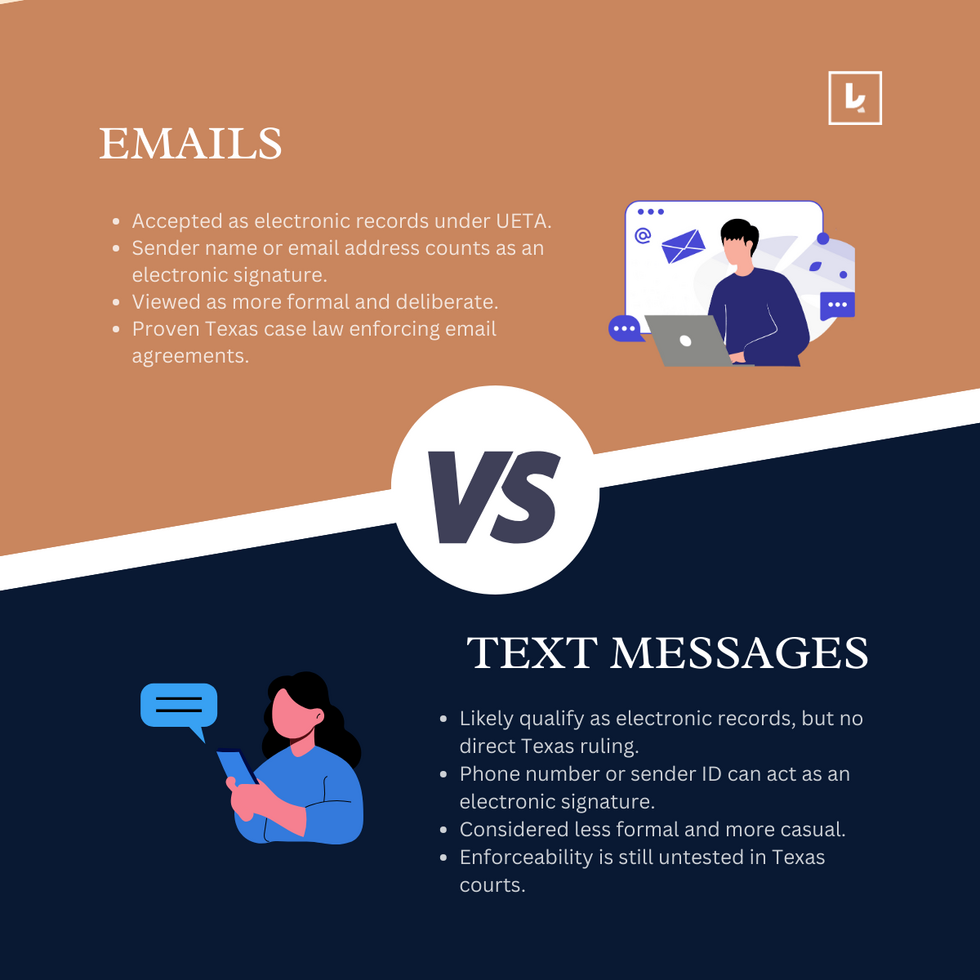
Texas courts already treat emails as valid electronic records when they show all the elements of a contract. Text messages likely meet the same standard because they identify the sender and can be authenticated, but courts have not ruled directly. Judges may also view texts as less formal than emails, which could create uncertainty about intent.
Key Takeaways for Texas Property Owners and Businesses
- A text message can be evidence of a contract if it shows offer, acceptance, consideration, capacity, and a signature or equivalent electronic mark.
- Under the UETA, a text that clearly identifies the sender can satisfy the signature requirement.
- The more detailed and formal the text exchange, the more likely a court is to view it as a contract.
- For important agreements, especially real estate sales or long-term leases, follow up with a formal written contract to avoid disputes.
The Keller Firm Can Help
Electronic agreements can create real legal risk. If you are involved in a Texas property dispute, need to enforce a text message contract, or simply want to protect your rights in an electronic transaction, contact The Keller Firm. Our attorneys can review your communications, explain your options, and help you move forward with confidence.
Disclaimer: This website is for informational purposes only and does not provide legal advice. Please do not act or refrain from acting based on anything you read on this site. Using this site or communicating with The Keller Firm through this site does not form an attorney/client relationship.

Comments
There are no comments for this post. Be the first and Add your Comment below.
Leave a Comment