

Texas Real Estate disputes can feel overwhelming, and it can be difficult to know where to start. This article explains frequent Texas property disputes in plain language, points to the law behind each one, and shows how a Real Estate attorney could help you. If you find yourself in a situation that fits into any of these categories, it may be time to contact an attorney.
What is a title dispute in Texas?
A title dispute focuses on the legal record of ownership, such as whether a deed, lien, mortgage, or other recorded instrument creates uncertainty about who owns the property or who has the right to possess it. In Texas, when a court must decide who holds superior title and the right to possession, that dispute is typically brought as a “trespass to try title” action under the Property Code. (Tex. Prop. Code Sec. 22.001.) A trespass to try title action is the statutory “method of determining title to lands, tenements, or other real property.”
If the issue is not a full-blown contest over who owns the property, but instead an allegedly invalid or unenforceable recorded claim (for example, a lien that should have been released), owners may file a suit to quiet title or remove a cloud on title—equitable remedies developed through Texas case law rather than a single statute, and often used to “clear” the records when the owner's underlying title is not in dispute.
Common examples:
-
You are trying to sell or refinance, and a title search turns up an old lien you did not know about.
-
Someone comes forth claiming they were an heir to a previous owner and did not consent to the sale of the property.
How a Texas Real Estate attorney could help: Trace the chain of title, identify whether a trespass to try title action, a suit to quiet title, or another remedy fits the problem, evaluate competing claims before legal proceedings begin, and then file suit on your behalf if necessary.
What is an ownership dispute in Texas?
Title disputes are often also ownership disputes, but there can be ownership disputes that are broader disagreements about who has what rights in a property that span beyond the legal title. These disputes may involve equitable or beneficial interests, such as resulting trusts, community-property claims, or a co-owner's share that is not clearly reflected in title records.
If a court ultimately has to decide which party's claim to title is superior, Texas generally channels that question into a trespass to try title framework. (Tex. Prop. Code Sec. 22.001.) When the dispute is not over whether someone is an owner at all, but instead over how to divide recognized ownership shares among co-owners, it often proceeds as a partition action. (Tex. Prop. Code Sec. 23.001.)
Common examples:
-
You and a former partner bought a home together and now disagree about who owns what and how to unwind the arrangement.
-
You paid for a property, but it is titled only in someone else's name.
-
You contributed to the purchase or improvement of a property and now claim an ownership interest that is not reflected in the deed.
How a Texas Real Estate attorney could help: Pinpoint the legal theory behind the dispute—whether contract, constructive trust, community property, partition, or title—so the requested remedy matches the facts and the governing statute or case law.
What is a partition action in Texas?
When co-owners cannot agree on what to do with jointly owned property, any joint owner can ask a court to divide the property through a partition action. Under Texas law, “a joint owner or claimant of real property or an interest in real property … may compel a partition of the interest or the property among the joint owners or claimants” under Tex. Prop. Code Sec. 23.001 and the Texas Rules of Civil Procedure.
A court can divide the property physically (partition in kind) when that can be done fairly, or order it sold and split the proceeds (partition by sale) when a physical division is not practical or would significantly diminish the value of the property. For inherited property held among relatives, the Texas Uniform Partition of Heirs' Property Act (Tex. Prop. Code ch. 23A, enacted in 2017) adds extra protections—such as appraisals, notice, and co-owner buyout rights—before any forced sale.
Common examples:
-
Two business partners own commercial property together, and one wants the court to divide or sell the property.
-
Co-owners of vacant land disagree about whether the land can be fairly divided into separate parcels.
-
You want out of a jointly owned property, but the other owner will not buy you out or agree to sell.
How a Texas Real Estate attorney could help: Determine which partition rules apply, explain whether any special protections—such as heirs' property protections under Chapter 23A—change the process, and assess whether a partition in kind or sale is realistic given the property and the co-owners' goals.
What is a boundary dispute in Texas?
A boundary or property line dispute is a disagreement over where the line between two properties actually sits, often involving fences, encroachments, driveways, or conflicting surveys. These disputes usually turn on the legal descriptions in the deeds, historical evidence, and one or more land surveys prepared by licensed surveyors.
Two doctrines come up frequently: adverse possession, where, in limited circumstances, long-term, qualifying possession can ripen into title if the record owner does not sue within the statutory limitations period; and the “agreed boundary” doctrine, a case-law rule under which neighbors may, in some circumstances, settle an uncertain line by agreement and consistent long-term possession. Both are heavily fact-specific and arise from Texas court decisions rather than a single statute. (Adverse-possession limitation periods appear in Tex. Civ. Prac. & Rem. Code Sec. 16.024–16.027.)
Common examples:
-
Your neighbor put up a fence that you believe is on your land.
-
A new survey shows your property line is not where you always assumed it was.
-
A neighbor's driveway, shed, or addition crosses onto your property.
How a Texas Real Estate attorney could help: Compare the deeds, surveys, and physical use of the property, then determine whether adverse possession, agreed boundary, or another theory affects where the legal boundary should be drawn.
What is an easement dispute in Texas?
An easement dispute is a conflict over the right to use part of someone else's land, such as a shared driveway, a utility corridor, or access across a neighbor's property to reach a landlocked tract.
Texas recognizes express easements, which are created in writing, often in a deed or separate easement agreement, and usually recorded in the county property records. Texas courts also recognize implied easements, easements by necessity for certain landlocked parcels, and prescriptive easements, all of which are primarily case-law doctrines rather than detailed statutory schemes. The elements differ depending on the type of easement, and whether one exists often turns on how the property was historically used and how long a particular use has continued.
Common examples:
-
A neighbor is blocking a shared driveway or road you use to reach your property.
-
Someone is using a path across your land and claims they have the right to continue.
-
Your property has no road access, and you need to cross a neighbor's land to reach it.
How a Texas Real Estate attorney could help: Review the recorded documents, interpret any easement language, identify what type of easement (if any) applies, and decide whether the disputed use stays within the easement's intended scope or has exceeded what the law allows.
What are contractor and construction disputes in Texas?
These disputes involve problems with workmanship, delays, payment, or scope on a construction project. For defects in residential construction, the Texas Residential Construction Liability Act (Tex. Prop. Code ch. 27) governs certain claims and limits the types of damages that may be recovered. The RCLA also requires a homeowner to send written notice of the alleged defects by certified mail at least 60 days before filing suit or demanding arbitration, and to allow the contractor an opportunity to inspect and make an offer of repair. (Tex. Prop. Code Sec. 27.004.)
Contractors, subcontractors, and suppliers can also secure payment through mechanics' and materialman's liens under Tex. Prop. Code ch. 53, which lays out detailed notice, filing, and deadline requirements. Because lien rights are purely statutory, strict compliance with Chapter 53 procedures is critical.
Common examples:
-
A contractor did work on your home that is defective or left unfinished.
-
A builder took your money and walked off the job or keeps missing deadlines.
-
A contractor filed a lien on your home over a bill you do not believe you owe.
How a Texas Real Estate attorney could help: They can confirm whether the RCLA applies, confirm any pre-suit notice requirement has been satisfied, evaluate the merits of a defect, delay, lien, or non-payment claim, and, if necessary, challenge an invalid lien under the Property Code.
What is a seller disclosure dispute in Texas?
A seller disclosure dispute arises when a buyer discovers a defect the seller knew about but did not disclose in the transaction. Texas requires sellers of most previously occupied single-family homes to provide a written Seller's Disclosure Notice covering the property's condition and certain known defects. (Tex. Prop. Code Sec. 5.008; the Texas Real Estate Commission publishes a form that satisfies the statutory minimum.)
When a seller fails to disclose a known material defect, a buyer may have several potential claims. Section 5.008 provides statutory disclosure duties and, in certain situations, contract remedies tied to those duties. Separately, buyers may bring common-law claims such as fraud or negligent misrepresentation, and, in some cases, claims under the Texas Deceptive Trade Practices Act (DTPA) if the buyer qualifies as a “consumer.” (Tex. Bus. & Com. Code Sec. 17.50.) The specific claims and remedies depend on the facts, including what the seller knew, what was disclosed, and what the buyer relied on.
Common examples:
-
You bought a home and discovered foundation or structural problems that the seller never mentioned.
-
You found out the house had flooded or had water damage that was not disclosed.
-
Major repairs surfaced soon after closing that the seller clearly knew about from prior work or reports.
How a Real Estate attorney could help: Determine whether the nondisclosure involved a known material defect, analyze the timing and content of the Seller's Disclosure Notice, connect the facts to the strongest available claims (contract, statutory, tort, and DTPA), and assess what damages or other relief may be recoverable.
What are probate-related property disputes in Texas?
These are conflicts over real estate left behind when someone dies. In Texas, a decedent's real property generally vests immediately in the heirs or devisees at death, subject to the administration of the estate. (Tex. Estates Code Sec. 101.001 through 101.051.) Disputes commonly arise over proving heirship, the validity of a will, or what to do with property that several heirs now share as co-owners. When heirs cannot agree, the property can be partitioned—either under the general partition rules in Chapter 23 or, if it qualifies as “heirs' property,” under the Texas Uniform Partition of Heirs' Property Act in Chapter 23A.
Common examples:
-
You inherited property with other family members, and no one agrees on who should live there, manage it, or receive income from it.
-
A loved one died without a will, and the family needs to determine the heirs before the property can be sold or transferred.
-
A will leaves real estate to one person, but another heir challenges the will's validity.
How a Texas Real Estate attorney could help: They could clarify how the property transfers under the will or intestacy statutes, coordinate with probate counsel if needed, decide whether probate proceedings, partition, or both are the better path, and explain how heirs' property protections may apply before any court-ordered sale.
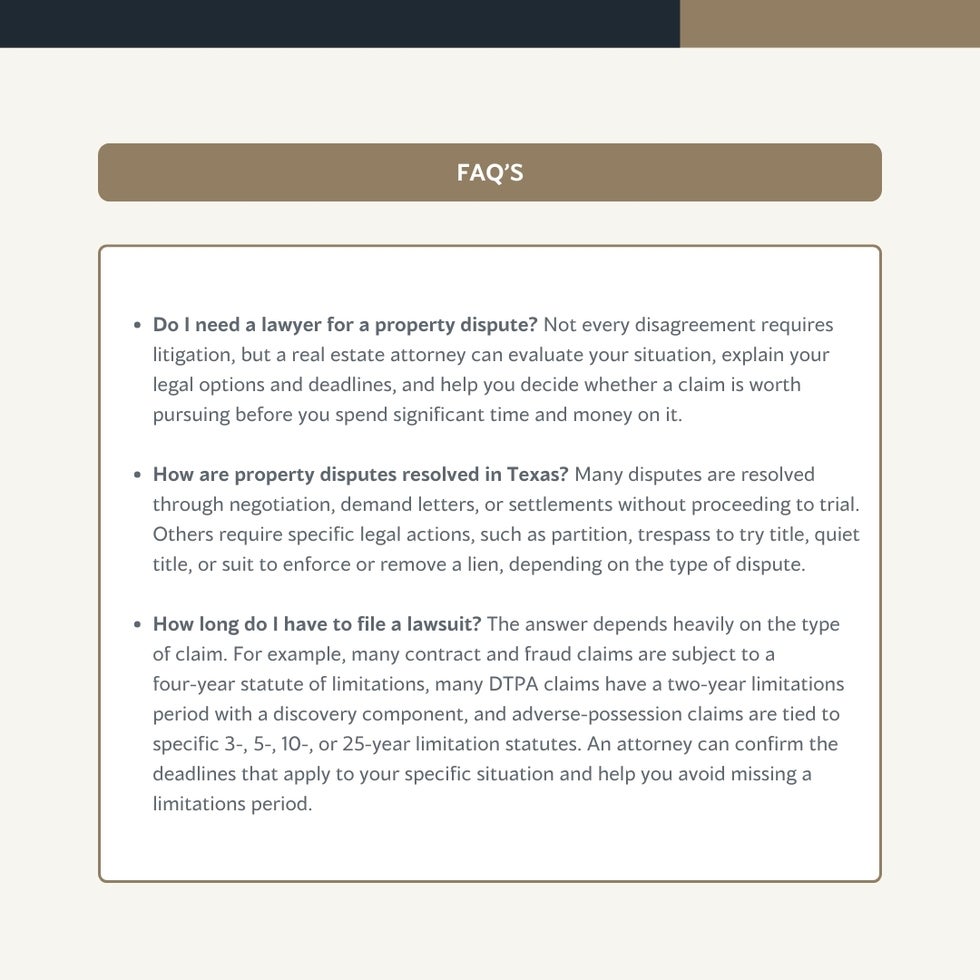
Not sure where your dispute stands?
If you are facing any of the disputes above, understanding where you stand before you commit to litigation can save significant time and expense. The Keller Firm focuses on Texas Real Estate and property disputes. Schedule a Strategy Session and learn how an attorney can evaluate your situation and walk you through your options.
Disclaimer: This website is for informational purposes only and does not constitute legal advice. Do not act or refrain from acting based on anything you read on this site. Use of this site or communication with The Keller Firm does not create an attorney-client relationship.
Sources
-
Trespass to try title: Tex. Prop. Code Sec. 22.001, https://statutes.capitol.texas.gov/Docs/PR/htm/PR.22.htm
-
Partition: Tex. Prop. Code Sec. 23.001, https://statutes.capitol.texas.gov/Docs/PR/htm/PR.23.htm
-
Uniform Partition of Heirs' Property Act: Tex. Prop. Code ch. 23A, https://statutes.capitol.texas.gov/Docs/PR/htm/PR.23A.htm
-
Seller's Disclosure of Property Condition: Tex. Prop. Code Sec. 5.008, https://statutes.capitol.texas.gov/Docs/PR/htm/PR.5.htm
-
TREC Seller's Disclosure Notice form, https://www.trec.texas.gov/forms/sellers-disclosure-notice-0
-
Residential Construction Liability Act: Tex. Prop. Code ch. 27, https://statutes.capitol.texas.gov/Docs/PR/htm/PR.27.htm
-
Mechanic's, Contractor's, or Materialman's Liens: Tex. Prop. Code ch. 53, https://statutes.capitol.texas.gov/Docs/PR/htm/PR.53.htm
-
Adverse possession periods: Tex. Civ. Prac. and Rem. Code Sec. 16.024 through 16.027, https://statutes.capitol.texas.gov/Docs/CP/htm/CP.16.htm
-
Limitations (contract, fraud, residual): Tex. Civ. Prac. and Rem. Code Sec. 16.004 and 16.051, https://statutes.capitol.texas.gov/Docs/CP/htm/CP.16.htm
-
Statute of Frauds: Tex. Bus. and Com. Code Sec. 26.01, https://statutes.capitol.texas.gov/Docs/BC/htm/BC.26.htm
-
DTPA (consumer cause of action, notice, limitations): Tex. Bus. and Com. Code Sec. 17.50, 17.505, 17.565, https://statutes.capitol.texas.gov/Docs/BC/htm/BC.17.htm
-
Vesting of decedent's property: Tex. Estates Code Sec. 101.001 through 101.051, https://statutes.capitol.texas.gov/Docs/ES/htm/ES.101.htm

Comments
There are no comments for this post. Be the first and Add your Comment below.
Leave a Comment