

Texas is a highly active market for real estate investments, and with that comes a high volume of renovation projects, value-add acquisitions, and fix-and-flip transactions. If you are active in this space, a mechanics lien is a legal issue you may encounter — either as a risk on a property you own or as a complication on one you are trying to buy.
Understanding how liens work before a problem arises is a practical way to evaluate risk of exposure.
What Is a Mechanics Lien?
A mechanics lien is a legal claim under Texas Property Code Chapter 53 that allows contractors, subcontractors, and material suppliers to attach a lien directly to a property when they haven't been paid for their work or materials. ¹
Once recorded, it clouds your title, making it difficult to sell or refinance until the lien is released or resolved. That means a lien recorded by an unpaid subcontractor can halt a planned sale, even if the deal is already under contract.
What HB 2237 Changed the Rules
House Bill 2237 took effect January 1, 2022, and applies to all prime contracts entered on or after that date. ³ It updated several aspects of Chapter 53 without changing the core affidavit deadlines.
A few of the more investor-relevant changes: Subcontractors now use a single standardized notice form sent simultaneously to both the owner and the original contractor, rather than separate notices to each.⁴ Notices can be sent by certified mail, registered mail, or traceable private delivery.² Owners also lost the ability to record an affidavit of completion to shorten subcontractors' filing deadlines — the statutory deadlines now control in all circumstances.²
On enforcement, HB 2237 tightened the timeline for commercial liens. On non-residential projects, a lien claimant must now file suit to foreclose within one year of the last date on which the affidavit could have been filed under Chapter 53. The parties can extend that window by written agreement — but not by more than one additional year, and the agreement must be recorded before the original deadline expires. ²
Residential and Non-Residential Properties Have Different Deadlines
Residential and non-residential projects operate under different rules. This is where Texas lien law may catch investors off guard.
Under Chapter 53, contractors who work directly with the property owner generally need to file a lien affidavit with the county clerk by the 15th day of the third month after the project is completed, terminated, or abandoned. On a non-residential project, that window extends to the 15th day of the fourth month. ¹ These core deadlines were not changed by HB 2237.²
Subcontractors and material suppliers follow the same affidavit deadlines but are subject to an additional notice requirement. They are typically required to send notice to both the property owner and the original contractor for each month in which unpaid labor or materials were furnished. On commercial projects, that notice is generally due by the 15th day of the third month following the month the work was performed. For residential projects, the deadline is shortened to the 15th day of the second month. ¹
Missing a single monthly notice can forfeit lien rights for that period. Texas courts apply these deadlines strictly, and a subcontractor who is not getting paid and continues to work must provide timely notice for each month to retain their lien rights.² If a deadline falls on a Saturday, Sunday, or legal holiday, it is extended to the next business day.²
The Scenario Investors Don't See Coming
As a hypothetical illustration, consider an investor who completes a full renovation on a non-residential property, pays the general contractor in full, and lists the property for sale. A month later, a subcontractor who was never paid by the general contractor records a lien on the property. The investor had no direct relationship with that subcontractor and had no idea the general contractor was not paying them.
Under Texas law, that subcontractor may have valid lien rights against the property regardless. ¹ This type of situation is not unusual, and it illustrates why understanding lien exposure is part of managing a renovation — not just managing a contractor.
Lien Waivers: Your Primary Line of Defense
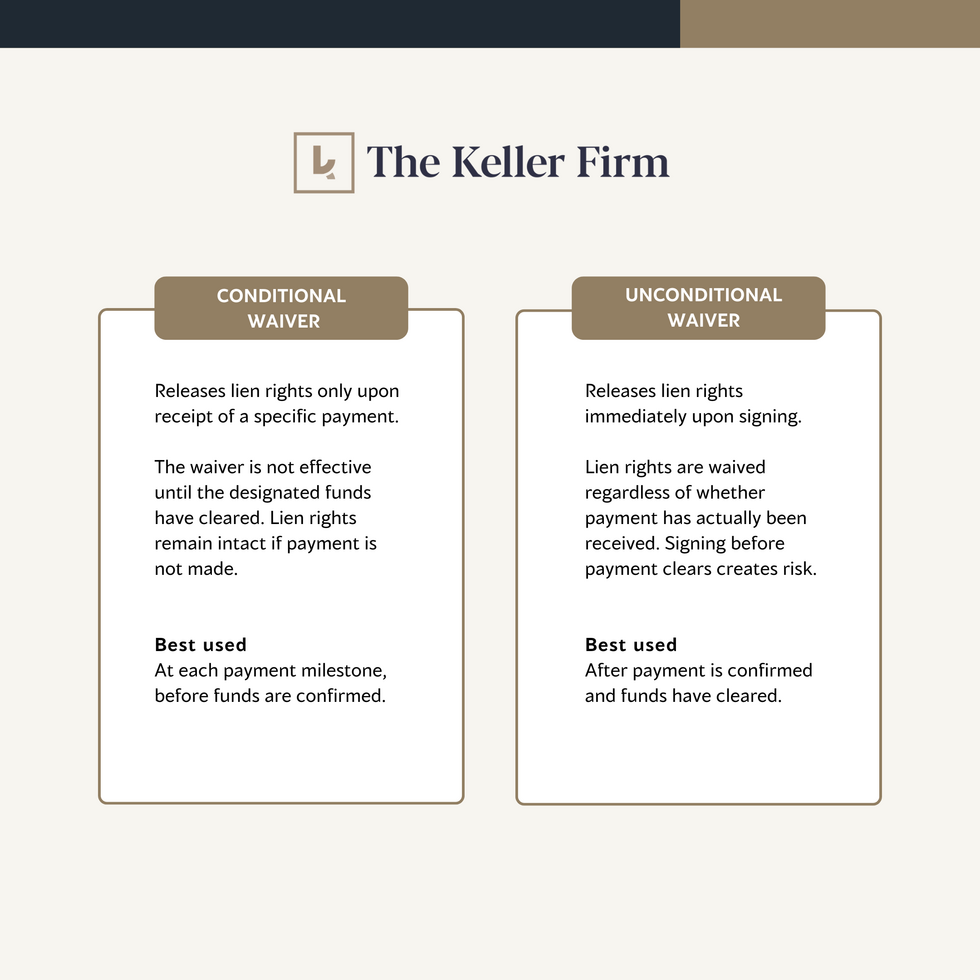
Lien waivers are the most practical tool investors have for managing this risk, and they are worth understanding in more detail.
Texas recognizes two types of lien waivers. A conditional waiver releases lien rights only upon receipt of a specific payment — meaning the waiver is not effective until the funds are clear. An unconditional waiver releases lien rights immediately upon signing, regardless of whether payment has been received. For that reason, unconditional waivers should be exchanged only after payment has been confirmed.
Under the post-HB 2237 framework, lien waivers no longer require notarization, but they must be in writing and signed.² Collecting conditional lien waivers from your general contractor and from major subcontractors at each payment milestone, then exchanging them for unconditional waivers once payment clears, is standard practice for investors running renovations in Texas.
One more thing worth knowing: even after a lien's one-year enforcement window has passed, the recorded document does not disappear on its own. It remains in the public record and continues to cloud title until it is formally released.
What Buyers Should Know
Mechanics lien exposure is not limited to investors who are actively renovating. If you are acquiring a property that has had recent construction work — a flip, a value-add renovation, or even recent repairs — existing liens or unfiled lien claims from that work can become your problem after closing.
Before purchasing any property with a recent construction history, a title search should specifically look for recorded liens and any open permits that might signal unfinished or disputed work. Even where no lien has been recorded yet, the filing window may still be open at the time of closing, meaning a lien could surface weeks later. Understanding that exposure before you close is far less costly than resolving it after.
Know Your Exposure Before a Problem Arises
Mechanics liens are a common part of the Texas construction landscape.
Contact a Texas real estate attorney if a lien has been recorded against your property, if you are purchasing a property with prior construction work and want to understand your title exposure, or if you have questions about how to structure contractor payments to protect your investment.
Sources
-
Tex. Prop. Code §§ 53.021–.023, 53.052, 53.056 — persons entitled to a lien, property subject to lien, filing deadlines, and notice requirements
Disclaimer: This website is for informational purposes only and does not constitute legal advice. Do not act or refrain from acting based on anything you read on this site. Use of this site or communication with The Keller Firm does not create an attorney-client relationship.

Comments
There are no comments for this post. Be the first and Add your Comment below.
Leave a Comment