

For most Texas homebuyers, sellers, and property owners, “lis pendens” is a term they only encounter when a real estate dispute or title issue has already surfaced.
Understanding what it means and what options may be available can dictate how you navigate your next steps.
What Is a Lis Pendens in Texas Real Estate?
"Lis pendens" is Latin for "suit pending." In Texas real estate, it refers to a written notice recorded in the county property records indicating that a lawsuit is pending involving a specific piece of property.
This notice does not decide the case or change ownership of the property. Instead, it serves as a public warning that a real estate lawsuit is pending and may affect ownership, title, or another property interest. Just as importantly, a lis pendens attaches to the property itself—not to the current owner—so it remains in place even if the property is sold before the lawsuit is resolved.
Why Lis Pendens Notices Get Filed in Texas Real Estate Disputes
Texas law does not permit a lis pendens to be filed in just any lawsuit. Under the Texas Property Code, the notice is appropriate when the underlying lawsuit directly involves real property — who owns it, who holds an interest in it, or whether a lien or encumbrance can be enforced against it.
Common situations include:
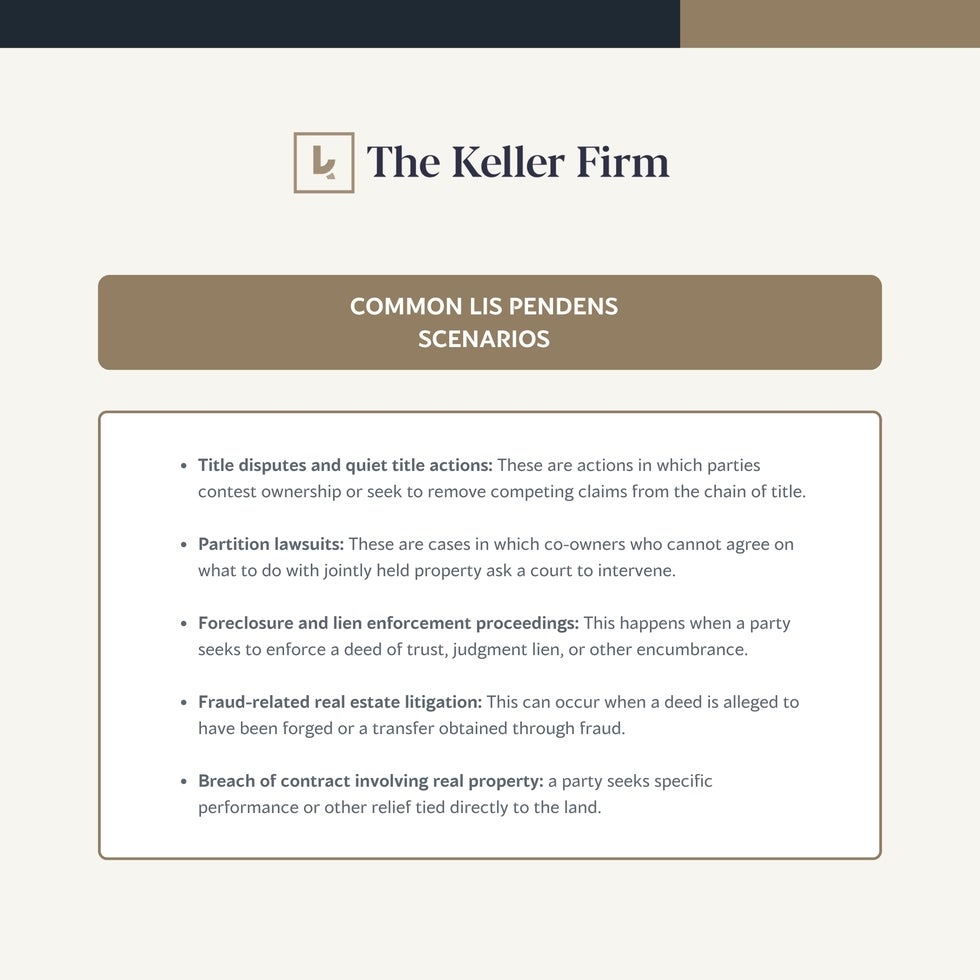
It's important to note that the notice is intended for disputes that affect the property itself—not for lawsuits seeking only monetary damages.
How a Texas Lis Pendens Affects a Sale, Refinance, or Purchase
Once recorded and indexed in the county records, a lis pendens serves as “constructive notice” to every one of its contents under the Texas Property Code. That means buyers, lenders, and others are legally treated as if they knew about the pending lawsuit, even if they never actually read the notice. It defeats bona fide purchaser status.
In practical terms, a lis pendens can have several effects:
-
Clouded title: Because the notice signals that a court is being asked to decide rights in the property, it creates a cloud on title that most buyers and lenders will not ignore.
-
Reluctant buyers and lenders: A purchaser who closes without resolving the issue risks stepping into the middle of litigation and possibly losing all or part of what they paid. Likewise, lenders are wary of loaning against collateral that may be tied up in a lawsuit.
-
Title insurance challenges: Title and underwriting sources note that title companies typically will not insure over a lis pendens, or they may require it to be resolved, expunged, or bonded around before issuing a policy.
-
Delays or dead deals: Because of these risks, a recorded lis pendens can delay or completely derail a sale, refinance, or purchase until the underlying dispute is resolved.
For someone already under contract, discovering a lis pendens late in the process can lead to extensions, renegotiations, or cancellation altogether.
How to Remove or Expunge a Lis Pendens in Texas
Texas law recognizes that lis pendens is a powerful tool and provides mechanisms to challenge it when appropriate. The key provisions are in Chapter 12 of the Texas Property Code.
A few important points from Chapter 12 include:
-
Statutory framework: Section 12.007 governs when a lis pendens may be filed and what the notice must contain, including: the court, case number, parties, and a legal description of the affected property.
-
Motion to expunge a lis pendens: Section 12.0071 allows an interested party to ask the court to expunge the notice. The court evaluates whether the underlying pleading asserts a real property claim and whether the claimant can demonstrate its probable validity.
-
Real property claim requirement: If the lawsuit does not genuinely involve title, ownership, or enforcement of a property interest, the court can order the lis pendens expunged.
-
Bond or deposit in lieu of notice: Under Section 12.008, a court may cancel a lis pendens when a deposit or bond adequately protects the claimant's interest, which can sometimes allow a transaction to proceed while the underlying dispute continues.
Once an order expunging or cancelling a lis pendens is properly recorded, the notice no longer operates as constructive notice to future purchasers or lenders.
What To Do If You Discover a Lis Pendens on Your Texas Property
If you discover a lis pendens on your property, taking a few prompt steps can help you understand the issue and protect your interests.
-
Start by identifying the underlying lawsuit. A lis pendens must include the court, case number, parties, and property description. Use that information to pull the case file through the county or district clerk's office or their online systems.
-
From there, understand what the plaintiff is actually asking the court to do. Is the suit seeking to change ownership, enforce a lien, or recover money? The nature of the claim affects both the validity of the lis pendens and your available options.
-
If you are mid-transaction, ask your real estate representative how the notice could affect closing, financing, and title insurance. A Real Estate attorney can also review whether the notice is proper and discuss options such as expunction, cancellation, negotiation, or bonding around the claim.
-
Most importantly, if there is a lis pendens on your property, it probably means you've been sued. You need to act quickly to determine the details of the suit and what you need to do to protect yourself from an adverse judgment.
Ignoring a lis pendens rarely makes it go away. Early legal guidance can help protect your interests and keep a viable transaction from falling apart.
Talk With a Texas Real Estate Attorney
If you have discovered a lis pendens affecting your Texas property or a transaction you are involved in, contact The Keller Firm to evaluate your situation and explain what options may be available under Texas law.
Disclaimer: This website is for informational purposes only and does not constitute legal advice. Do not act or refrain from acting based on anything you read on this site. Use of this site or communication with The Keller Firm does not create an attorney-client relationship.
Sources
-
Texas Property Code, Chapter 12 – Recording of Instruments (including §§ 12.007, 12.0071, 12.008)
https://statutes.capitol.texas.gov/Docs/PR/htm/PR.12.htm
-
Texas Property Code § 13.004 – Effect of Recording Lis Pendens
https://statutes.capitol.texas.gov/GetStatute.aspx?Code=PR&Value=13.004
-
Tarrant County Law Library – Lis Pendens Research Guide (PDF)
https://www.tarrantcountytx.gov/content/dam/main/law-library/pdfs/research-guides/Lis_Pendens_Research_Guide.pdf
-
St. Mary's Law Journal – “Texas Statutory Notice of Lis Pendens” (law review article, PDF)
https://commons.stmarytx.edu/cgi/viewcontent.cgi?article=2533&context=thestmaryslawjournal
-
Texas Law Help – Property Deed Basics (for general deed/recording context)
https://texaslawhelp.org/article/property-deed-basics
-
Texas Title Industry / Underwriting reference – “The Red Flag of Lis Pendens – What You Need to Know” (CourthouseDirect.com)
https://info.courthousedirect.com/blog/what-you-need-to-know-about-lis-pendens

Comments
There are no comments for this post. Be the first and Add your Comment below.
Leave a Comment