

What Unmarried Couples Need to Know Before Buying Property in Texas
You and your partner found the perfect home in Texas, but you're not married. Now what?
Unmarried couples buying a house in Texas face unique legal risks that most people don't realize until it's too late. Without the legal protections of marriage, everything from financing to ownership to future disputes can get complicated.
Here's what you should know before signing a contract or closing on a home together:
Texas Law Doesn't Automatically Protect Unmarried Couples
Married couples in Texas are covered under community property laws. This means assets (like a house) purchased during the marriage are considered jointly owned even if only one spouse is on the title.
But for unmarried couples, those protections don't exist.
Texas property rights for unmarried couples depend entirely on how the property is titled and what you put in writing. Without proper legal planning, you could face:
- Disagreements over ownership
- Unequal financial burdens
- Legal conflict if one person wants to sell or move out
- Probate complications if one partner passes away
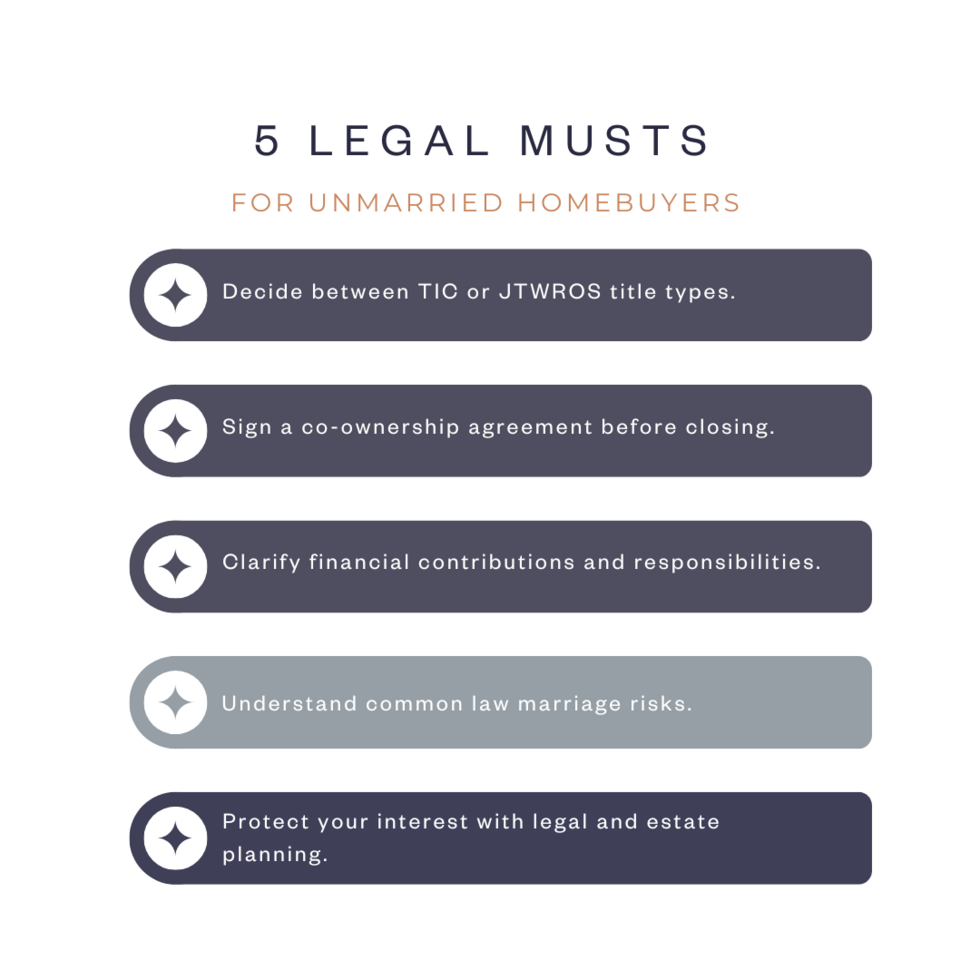
Step 1: Decide How You'll Hold Title
How the home is titled determines who legally owns what. In Texas, couples typically choose between:
Tenants in Common (TIC)
- Each person owns a defined share (e.g., 50/50 or 70/30)
- Shares can be unequal based on contributions
- If one partner dies, their share goes to their estate, not the surviving partner
- This is the default ownership type in Texas if nothing else is specified
Joint Tenants with Right of Survivorship (JTWROS)
- Both partners own equal shares
- If one partner dies, their share automatically transfers to the surviving partner
- Must be explicitly written into the deed, it's not the default under Texas law
Tip: Before closing, talk to a real estate attorney to make sure your deed matches your intentions.
Read more about TIC versus JTWROS.
Step 2: Draft a Co-Ownership Agreement
This is one of the most important legal tools for unmarried couples buying a house in Texas. A co-ownership agreement in Texas sets clear expectations and helps prevent future disputes.
This agreement should include:
- Ownership percentages
- Who pays for what (mortgage, insurance, taxes, repairs)
- What happens if the relationship ends
- Buyout terms and sale procedures
- What happens if one person dies or wants out
Without this, even simple disagreements can become costly legal battles.
Step 3: Talk Honestly About Finances
You don't need to split everything 50/50, but you do need to agree on the terms.
If one partner contributes more toward the down payment, covers repairs, or is solely on the mortgage, that needs to be documented. Without it, Texas courts may assume equal ownership, which may not reflect reality.
Things to discuss:
- Will both names be on the deed and mortgage?
- Are financial contributions equal or proportional?
- What happens if one person loses their job?
- How will future expenses or improvements be shared?
Financial transparency now prevents conflict later.
Step 4: Understand the Risks of Common Law Marriage
Texas recognizes common law marriage, which means even without a ceremony, a couple could be considered legally married if:
- You agree to be married
- You live together in Texas
- You hold yourselves out as married to others
This can cause confusion if one person later claims marital rights to the home. If you're intentionally not married, yourco-ownership agreement should clarify that.
Step 5: Protect Your Future with Legal Planning
Whether the relationship works out or not, the home is a significant investment. To protect yourself:
- Work with a real estate attorney before you buy
- Ensure your names are properly listed on the deed
- Sign a real estate contract for unmarried couples (aka co-ownership agreement)
- Consider updating your will or beneficiary designations
- Discuss life insurance or other safeguards if one partner passes away
Legal advice for unmarried homebuyers doesn't just protect your property; it gives you peace of mind
Have questions about buying property with your partner? Explore our resources or reach out to learn how The Keller Firm supports Texas buyers with co-ownership planning, contract drafting, and real estate protection strategies.
Disclaimer: This website is for informational purposes only and does not constitute legal advice. Do not act or refrain from acting based on the content of this site. Use of this site or communication with The Keller Firm through this site does not establish an attorney-client relationship.

Comments
There are no comments for this post. Be the first and Add your Comment below.
Leave a Comment