

Texas does not have a unified short-term rental (STR) law. The absence of a statewide framework introduces nuance and jurisdiction-specific interpretation, contributing to a significant number of investor disputes.
Without a statewide framework, the rules governing your Airbnb or VRBO property are determined by whoever has jurisdiction over it — and in Texas, that could be your homeowners association (HOA), your city, your deed restrictions, or all three at once.
Investors who do not navigate this landscape before closing on a property may encounter issues later in the process, including after the property is listed, bookings have begun, and an enforcement notice has been received.
HOA Restrictions and Deed Covenants: A Common Source of Disputes
For investors operating within a homeowner's association, one of the first questions to consider is whether the HOA's governing documents prohibit short-term rentals.
In Tarr v. Timberwood Park Owners Association, the Texas Supreme Court held that a generic "single-family residential use" restriction does not automatically prohibit short-term rentals. Using a home for short stays — where guests sleep, eat, and live in a normal residential way — still qualifies as residential use under that type of general language.¹
However, that ruling does not mean short-term rental investors are in the clear. The Tarr decision makes it equally clear that HOAs can restrict or ban short-term rentals — but only if their governing documents contain specific and unambiguous language, such as a defined minimum lease duration or an explicit prohibition on rentals of less than a set number of days.¹ HOAs that lack that language today can also amend their governing documents to add it, which creates ongoing legal risk for investors who are already operating.¹
It is worth pointing out that guests who violate HOA rules — noise, parking, amenity access — create liability for the property owner, not the guest. And some HOAs now require short-term rental listings to be registered with or approved by the board before going live. Investors who skip that step can face fines, suspension of rights, or enforcement actions that cloud the property's title.
Municipal Licensing: Houston, Austin, and Dallas Are All Moving
Beyond HOA rules, Texas cities are actively tightening short-term rental regulations, and the requirements vary by market.
Houston: Now requires all short-term rental operators to obtain a city certificate of registration, one per property. Registration opened in August 2025, and as enforcement ramps up, platforms are being directed to remove listings that lack a valid city certificate number. ² Local short-term rental ordinances and licensing rules are evolving — investors should verify current requirements for their specific address before listing.
Austin: Has required short-term rental licenses since 2016, but enforcement has historically been inconsistent. That is changing. The Austin City Council approved new regulations in 2025, and by July 2026, all short-term rental listings on platforms like Airbnb and VRBO must display a valid city-issued license number or face removal.³ The city has also added caps on short-term rental density in multifamily and single-family sites, and operators are now required to maintain a local contact in Central Texas.³
Dallas: Has tied short-term rental legality to zoning, effectively prohibiting short-term rentals in most single-family residential zones while permitting limited short-term rental use in certain multifamily and commercial areas under specific registration conditions.
Across all three cities, the state of Texas also imposes a 6% hotel occupancy tax on rentals of less than 30 days, and most municipalities stack their own local lodging taxes on top of that. Non-compliance with HOT obligations creates both financial exposure and legal risk for investors.
Co-Ownership Disputes: A Growing Litigation Area
Many short-term rental investors purchase properties with partners — a joint acquisition that makes financial sense until a disagreement arises. When co-owners split on how a property should be used, managed, or eventually sold, the short-term rental itself often becomes the flashpoint.
Under Texas law, any co-tenant may seek a partition of real property. If an in-kind division is not practicable, a court can order a partition by sale — forcing the property onto the market regardless of whether either party wants to sell at that moment. Co-ownership disputes involving short-term rentals are an increasingly active area of Texas property litigation, particularly among small investor groups who structured their ownership informally and without a detailed operating agreement.
What to Assess Before You Buy
The most effective time to identify short-term rental legal risk is before closing — not after. A few areas that warrant specific attention on any short-term rental acquisition:
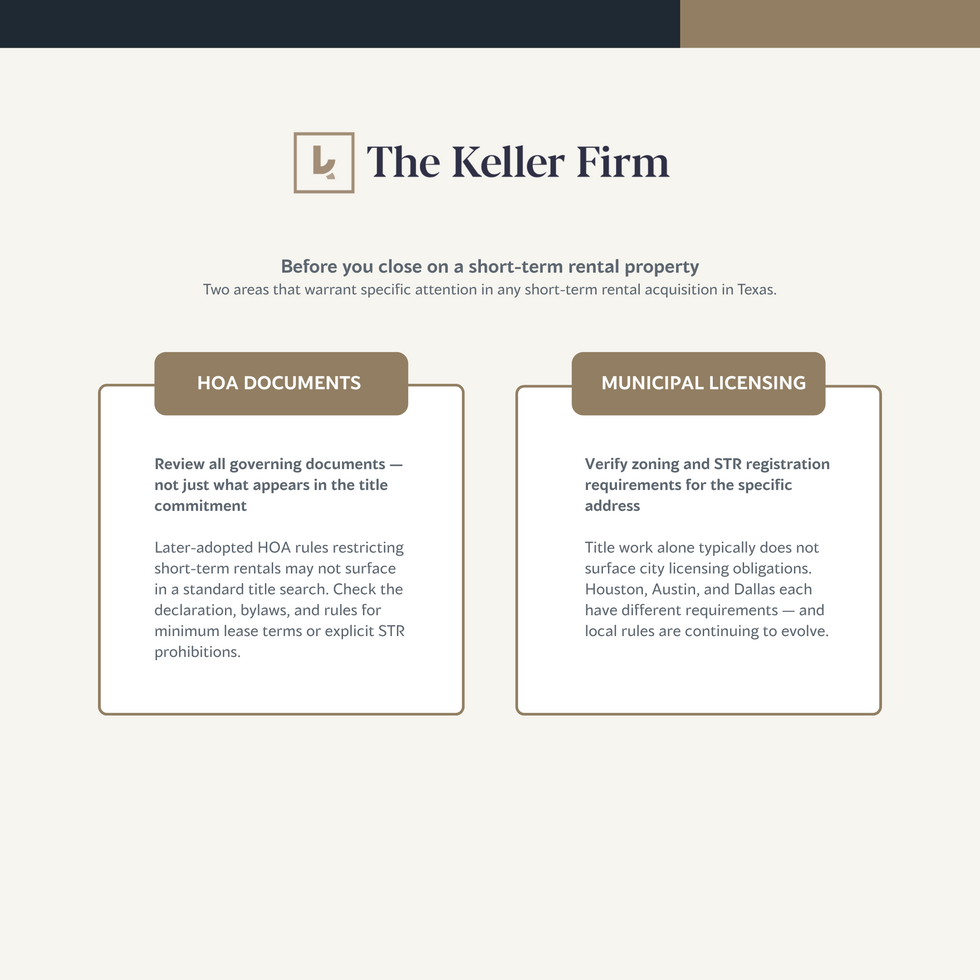
Review the HOA's declaration, bylaws, and rules — not just the covenants, conditions, and restrictions that may appear in the title commitment. Later-adopted HOA rules that restrict short-term rentals will likely not appear.⁴ Check municipal zoning and short-term rental registration requirements for the specific address as well to make sure there won't be any issues with using the property for its intended purpose.⁴ If purchasing with a partner, document the co-ownership arrangement, decision-making authority, and exit strategy in writing before closing.
Before the Dispute Finds You
Short-term rental investing in Texas can be financially rewarding — but the legal landscape is more complex than the platform makes it look. HOA enforcement, municipal licensing, and co-ownership conflicts are all active sources of litigation for short-term rental investors across the state.
Contact a Texas real estate attorney if you are facing an HOA enforcement action related to your short-term rental, if a co-ownership dispute is affecting your ability to operate or sell a short-term rental property, or if you want to understand the legal risks before purchasing a property you intend to list on Airbnb or VRBO.
Sources
-
Manning & Meyers, Can HOAs Ban Short-Term Rentals in 2025? — discussing Tarr v. Timberwood Park Owners Association and post-Tarr HOA authority
Disclaimer: This website is for informational purposes only and does not constitute legal advice. Do not act or refrain from acting based on anything you read on this site. Use of this site or communication with The Keller Firm does not create an attorney-client relationship.

Comments
There are no comments for this post. Be the first and Add your Comment below.
Leave a Comment